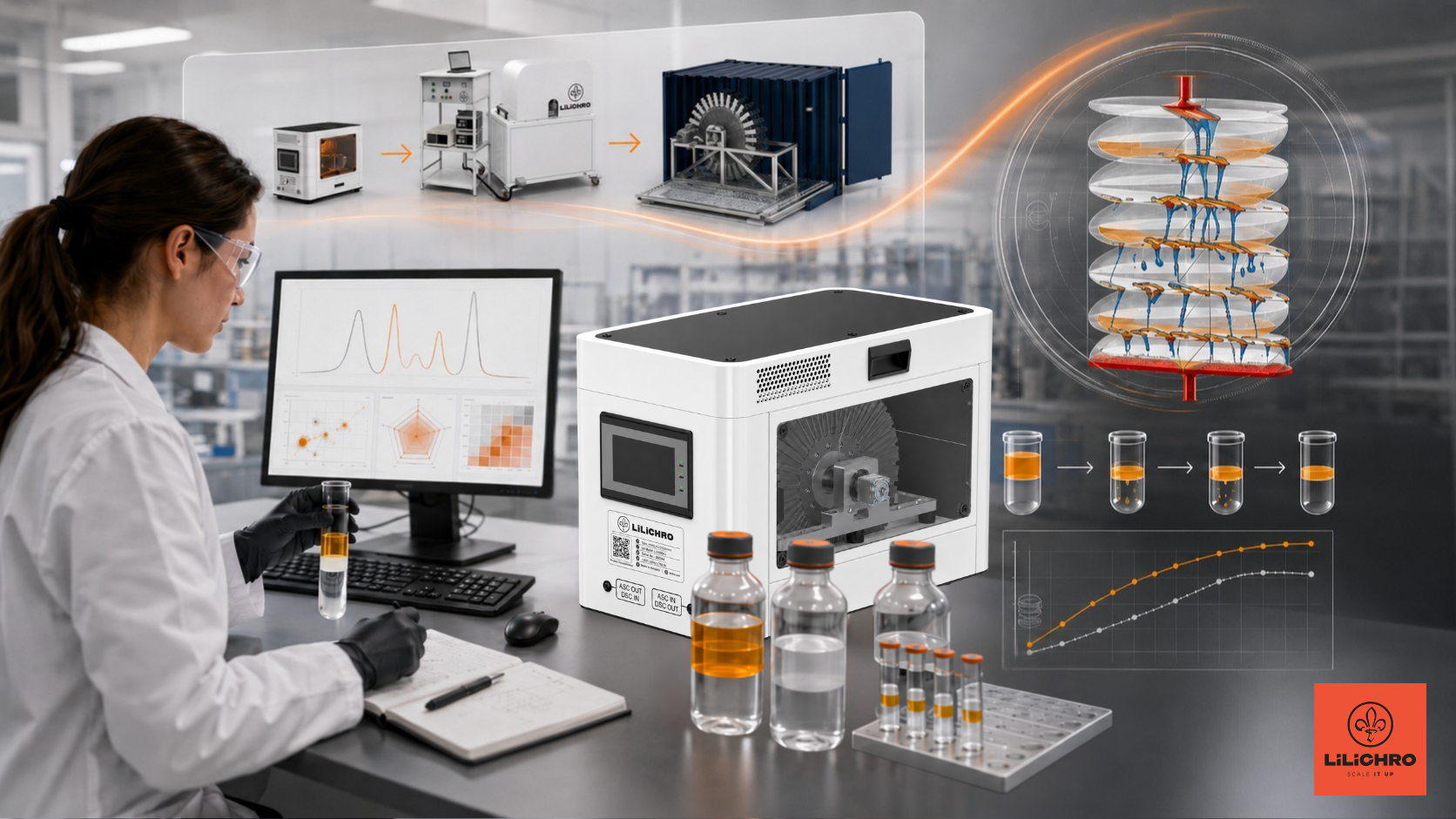
Selecting a preparative chromatography method should begin with the feed not the instrument.
The target’s polarity and structure, its solubility, the impurities present, matrix load, required selectivity and production volume all influence whether C18 reversed-phase chromatography, normal-phase chromatography or centrifugal partition chromatography (CPC) is the most practical choice.
C18 Reversed Phase: Broad Applicability, Expensive Protection
C18 chromatography uses a non-polar bonded stationary phase and a relatively polar mobile phase, typically water combined with acetonitrile or methanol. Retention reflects differences in analyte affinity between these environments.
One reason reversed phase became so widely adopted is its broad solvent compatibility. If a compound dissolves at a useful concentration in a compatible aqueous–acetonitrile or aqueous–methanol system, there is a reasonable chance that an effective chromatographic method can be developed, although solubility alone does not guarantee selectivity or loading capacity.
C18 is especially suitable when:
- High resolution is required
- The feed is relatively clean
- Closely related compounds or structural isomers must be separated
- An analytical reversed-phase method already exists
The main limitation is the cost and vulnerability of the stationary phase. Chlorophylls, carotenoids, lipids and other strongly hydrophobic plant-derived components can accumulate on the column. Regeneration may recover some performance, but persistent contamination can permanently reduce efficiency or change selectivity.
Preparative C18 is used at production scale, but its economics may become unattractive when large amounts of crude matrix require extensive pretreatment, repeated regeneration or frequent replacement of expensive columns.
Normal Phase: Adsorption Selectivity with Disposable Silica
Normal-phase chromatography typically uses polar silica and a predominantly non-polar mobile phase. Separation occurs mainly through adsorption onto active surface sites, particularly silanol groups.
Instead of partitioning between two bulk liquid phases, the stationary phase acts as a selective brake: compounds interacting more strongly with the silica move more slowly through the column.
Normal phase is particularly useful for:
- Non-polar or moderately polar compounds
- Rigid molecules with subtle structural differences
- Positional and geometric isomers
- Samples soluble at useful concentrations in non-polar mobile phases
Its usefulness is strongly determined by solubility. Promising selectivity has little preparative value if the sample cannot be loaded at a sufficiently high concentration.
Normal phase can sometimes handle matrix-contaminated feeds more economically than C18. Chlorophylls, carotenoids and other strongly retained components may contaminate the bed, but inexpensive silica or disposable flash media can simply be replaced. Insoluble salts and particulates, however, generally require removal before loading because they can precipitate or block the column.
The main risk is adsorption-related product loss. Strongly retained targets may show poor recovery or require aggressive conditions for elution.
CPC: Partitioning Between Two Liquid Phases
CPC uses two immiscible liquid phases. One is retained inside the rotor by centrifugal force, while the other is pumped through it. Compounds separate according to differences in their partition coefficients.
Like reversed-phase chromatography, CPC can exploit differences in affinity between relatively polar and non-polar environments. Unlike C18, however, it uses two bulk liquid phases and no bonded solid stationary phase.
A suitable CPC separation requires:
- Adequate target solubility in the biphasic solvent system
- A useful difference between the partition coefficients of the target and critical impurities
The target does not need to dissolve equally well in both phases, but it must distribute between them sufficiently to achieve practical retention. By changing the solvent composition, operating mode, pH or additives, CPC can accommodate compounds across a broad polarity range.
Common candidates include small and medium-sized natural-product molecules, such as cannabinoids including CBD, alkaloids such as mitragynine, and selected terpenoids. CPC can also be evaluated for removing unwanted alkaloids or pigments from valuable natural-product fractions, including peptide-containing extracts.
CPC is generally the least sensitive of the three methods to large amounts of crude matrix. Because there is no permanently packed bed, the liquid stationary phase can be displaced and replaced, while the rotor can be cleaned. This reduces the risk of irreversible adsorption and permanent column fouling.
Matrix tolerance is not unlimited. Particulates, emulsifying components and materials that disturb phase settling may still require feed preparation or solvent-system adjustment.
CPC can also separate structural isomers when their partition coefficients differ sufficiently. However, C18 and normal phase often provide higher efficiency for especially demanding isomer separations.
Practical Method Comparison
Practical Preparative Method Comparison
| Process criterion |
C18 reversed phase |
Normal phase |
CPC |
| Large-scale production |
Broad applicability; preferred for water-soluble targets and peptides; high stationary-phase and solvent cost |
Non-polar targets; high loading capacity; economical silica; typical ratio: 1 kg irregular silica per 10 L solvent |
Best cost potential if targets are partitioning in two liquid phases; no solid stationary phase |
Structural-isomer separation
(non-enantiomer) |
Simple but expensive route when upgrading from analytical method |
Selectivity for differences in rigid molecular regions: cis/trans geometry, hydroxyl–oxo functionality, ring stereoisomeria |
Selectivity from differential solubility and partition coefficients between liquid phases |
| High crude-matrix load |
Matrix removal typically required; high clogging risk; costly stationary-phase protection |
1. Often two stages: matrix removal, then target separation;
2. alternative single-use with low-cost silica |
High crude-feed tolerance; solids filtration may be required; no irreversible silica clogging |
| Primary limitations |
Stationary-phase cost; high pressure; clogging; limited loading capacity |
Solvent-dependent silica swelling; weak polar-compound compatibility; non-economical regeneration; silica-handling and silicosis risk |
Target solubility; solvent-system selection; biphasic-system stability |
Selection note: Confirm with representative crude feed. Compare resolution, loading, recovery, solvent demand and production economics.
Let the Feed Choose the Method
C18 is often the strongest option for clean feeds and high-resolution separations. Normal phase is well suited to many non-polar, structurally rigid compounds and can remain economical when inexpensive silica is disposable. CPC becomes particularly relevant when substantial crude matrix, adsorption-related losses or recurring stationary-phase costs make packed columns impractical.
Selectivity is only the beginning. Loading capacity, sample concentration, target recovery and solvent consumption must ultimately be tested using representative crude material.
LiLiChro’s Screening Study evaluates whether the target and critical impurities have suitable solubility and liquid–liquid partition selectivity before full CPC method development begins.

.png?width=1200&height=628&name=lilichro%20blog%20cpc%20natural%20extract%20purification%20(1).png)
.png?width=1200&height=628&name=HubSpot%20Blog%20Post%20Header%20(5).png)