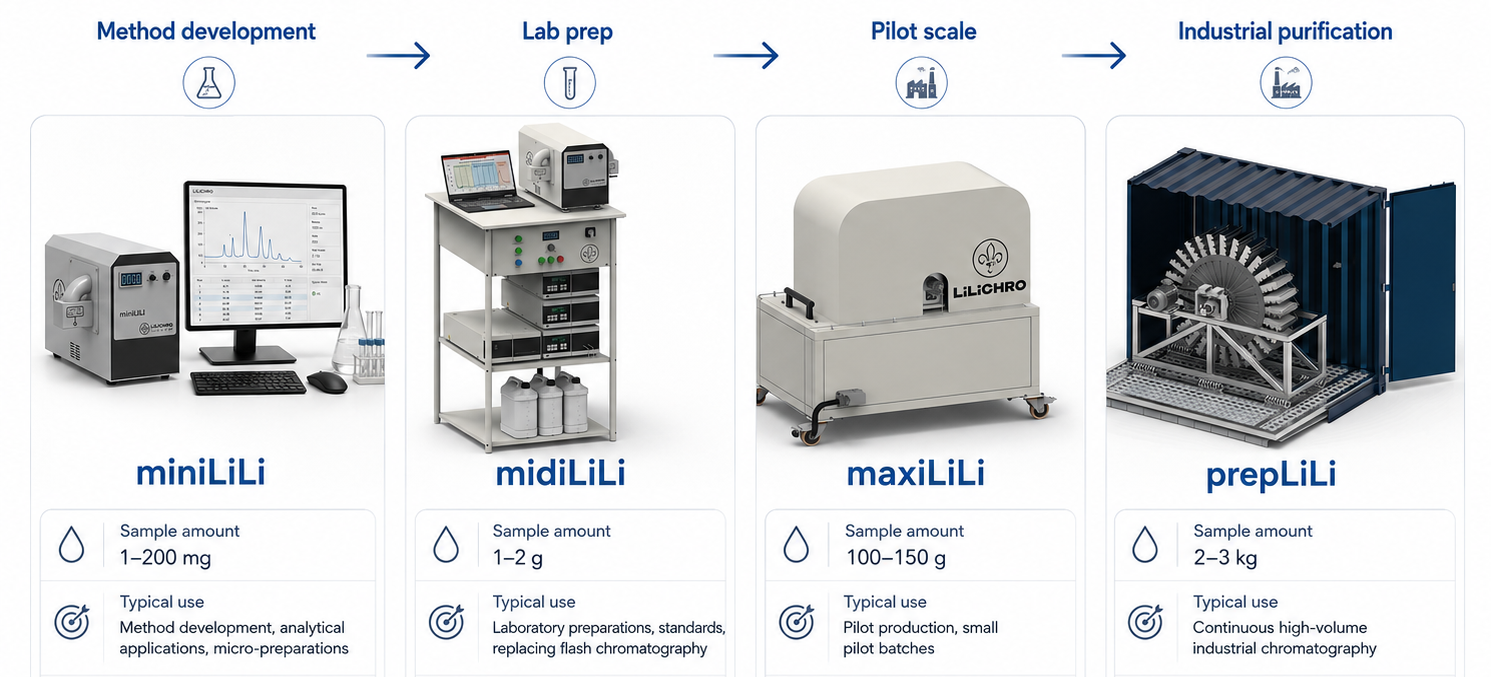
CPC
Scaling up
method development
.png?width=1200&height=628&name=lilichro%20blog%20cpc%20natural%20extract%20purification%20(1).png)

Preparative chromatography is not automatically the next step after synthesis or extraction. It is one of several purification options alongside crystallization, precipitation, extraction, distillation and membrane-based methods.
Its purpose is to isolate a target compound at the quantity and purity required for further processing or use. The real question is therefore not whether chromatography can separate the mixture. It is whether the separation justifies its development time, solvent use and operating cost.
Molecular size can influence method selection, but it is rarely decisive on its own. More useful questions are:
These questions create three common process situations.
For an inexpensive product produced through a short, selective synthesis, preparative chromatography may be difficult to justify. If crystallization, washing, extraction or distillation gives the required result, adding chromatography merely creates an expensive scenic route.
However, even a simple small molecule may require chromatography when closely related impurities remain, the available quantity is limited or the required purity cannot be achieved selectively by simpler methods.
The economics change after a long synthetic route. Ten steps is not a universal threshold, but it illustrates the principle: by the final stage, considerable material, time and process value have accumulated.
Typical purification challenges include:
When these compounds have similar physical properties, repeated crystallization or extraction may sacrifice too much product. Preparative chromatography can then protect the value created upstream, even if the separation itself is relatively expensive.
Fermentation broths, plant extracts and other biological feedstocks present a different opponent: the matrix.
The target may be surrounded by pigments, lipids, proteins, salts, structurally related metabolites and degradation products. Importantly, the target compound itself may still be a small molecule. It is the origin and complexity of the mixture—not simply molecular weight—that creates the purification challenge.
Many processes follow a three-stage logic:
Chromatography does not always need to deliver the finished product directly. Its most valuable role may be converting a difficult crude mixture into a fraction that makes the final purification straightforward.
.png?width=1200&height=628&name=HubSpot%20Blog%20Post%20Header%20(3).png)
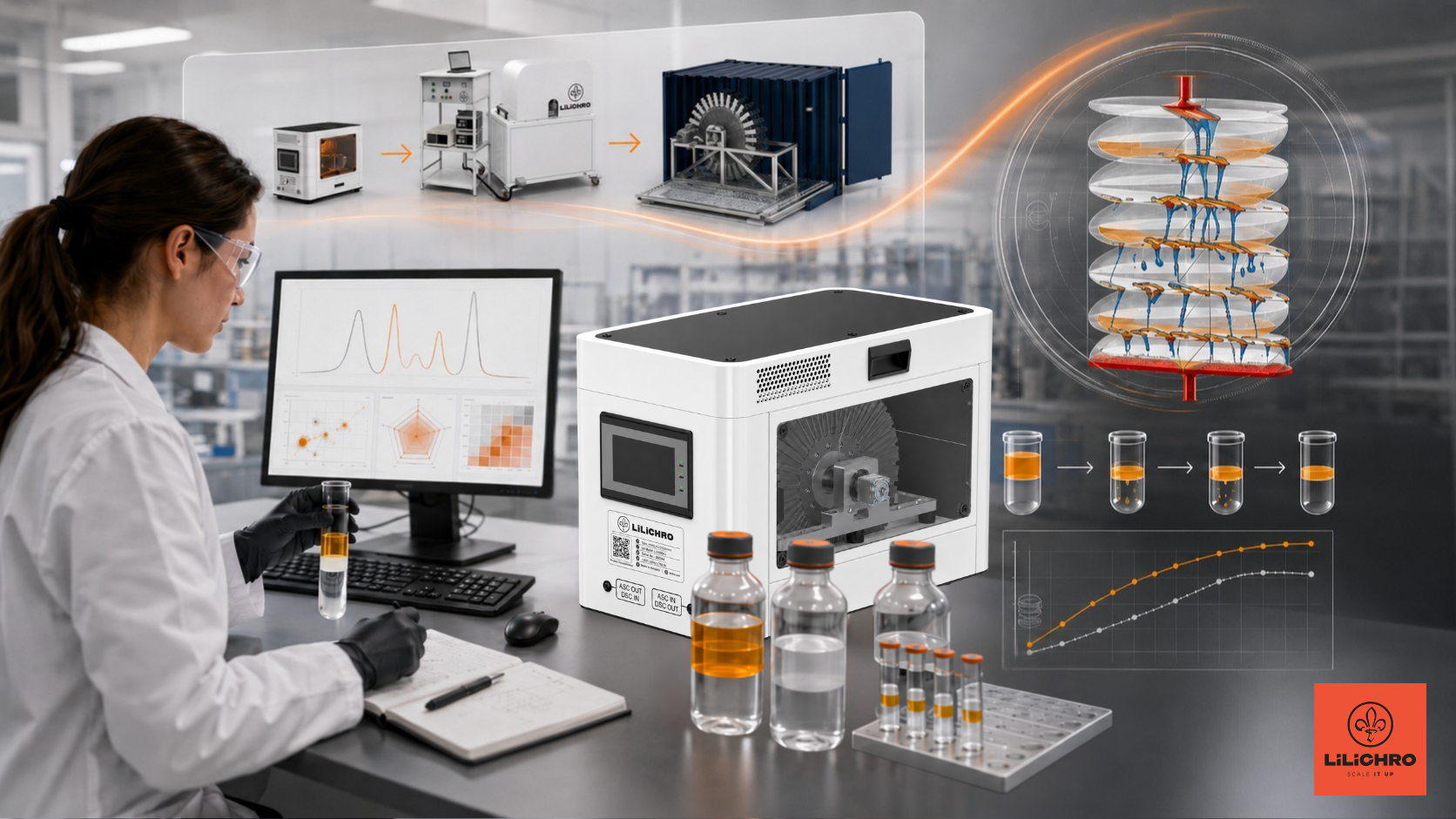
Centrifugal partition chromatography (CPC) is a preparative liquid–liquid chromatography technique. Instead of a packed solid stationary phase, it separates compounds through their partitioning between two immiscible liquid phases.
CPC may be worth investigating when solid-phase adsorption causes recovery problems, the crude mixture has a demanding matrix, or conventional column loading becomes restrictive. It is not automatically suitable for every sample: success depends on identifying a biphasic solvent system that provides useful selectivity and adequate phase behaviour.
No, but product value strongly affects whether its cost is justified. Throughput, recovery and downstream savings must also be considered.
No. Preparative performance also depends on loading, recovery, cycle time, fraction handling and scalability.
A small-scale solvent and sample screening can show whether the target and critical impurities have sufficiently different partition behaviour.
If simpler purification operations are no longer delivering the required selectivity, a LiLiChro Screening Study can assess whether CPC offers a feasible route before committing to full method development.