
CPC
LLC
Natural Extract

Discover how liquid-liquid chromatography delivers fully linear scale-up from lab screening to industrial production without the recovery loss and unpredictable performance of solid-phase methods.
In pharmaceutical manufacturing, the path from analytical method development to industrial-scale production is fraught with uncertainty. Lab managers and heads of purification routinely face a critical challenge: methods that perform brilliantly at analytical scale often fail unpredictably when transferred to pilot or production volumes. This non-linear scale-up behavior introduces costly delays, compromises product recovery, and forces extensive revalidation—consuming resources and extending time-to-market for valuable active pharmaceutical ingredients.
Linear scale-up represents a fundamental advantage in purification science. When a separation method scales linearly, the performance parameters observed during laboratory screening—partition coefficients, resolution, recovery yields, and solvent consumption ratios—translate predictably to larger volumes through simple geometric multiplication. The separation mechanism remains constant across scales because the underlying physical chemistry governing compound partitioning between two liquid phases is inherently independent of equipment size.
Liquid-liquid chromatography achieves this predictable scalability through support-free molecule separation. Unlike methods relying on solid stationary phases where surface interactions, packing density variations, and flow distribution irregularities create scale-dependent behavior, two-liquid-phase purification depends solely on equilibrium partitioning. This thermodynamic foundation ensures that what separates effectively in a 25 mL rotor will separate identically in a 5-liter production system—differing only in throughput capacity, not in separation quality or compound recovery.
The physics underlying liquid-liquid chromatography scalability derives from fundamental partition equilibria between immiscible solvent phases. When a compound mixture enters a biphasic solvent system, each component distributes according to its partition coefficient—the ratio of its concentration in the stationary liquid phase versus the mobile liquid phase. This partition coefficient remains constant regardless of system volume, provided temperature and solvent composition are maintained. Consequently, increasing rotor volume proportionally increases sample loading capacity while preserving separation resolution and compound recovery.
László Frici Németh's pioneering work with Z-cell rotor geometry revolutionized the practical implementation of centrifugal partition chromatography. The Z-cell design features a series of interconnected chambers arranged along the rotor radius, each functioning as a discrete mixing and settling zone where the two liquid phases contact intimately before separating under centrifugal force. This geometric configuration maximizes interfacial surface area between phases while maintaining efficient phase retention—critical parameters that directly influence mass transfer efficiency and separation performance.
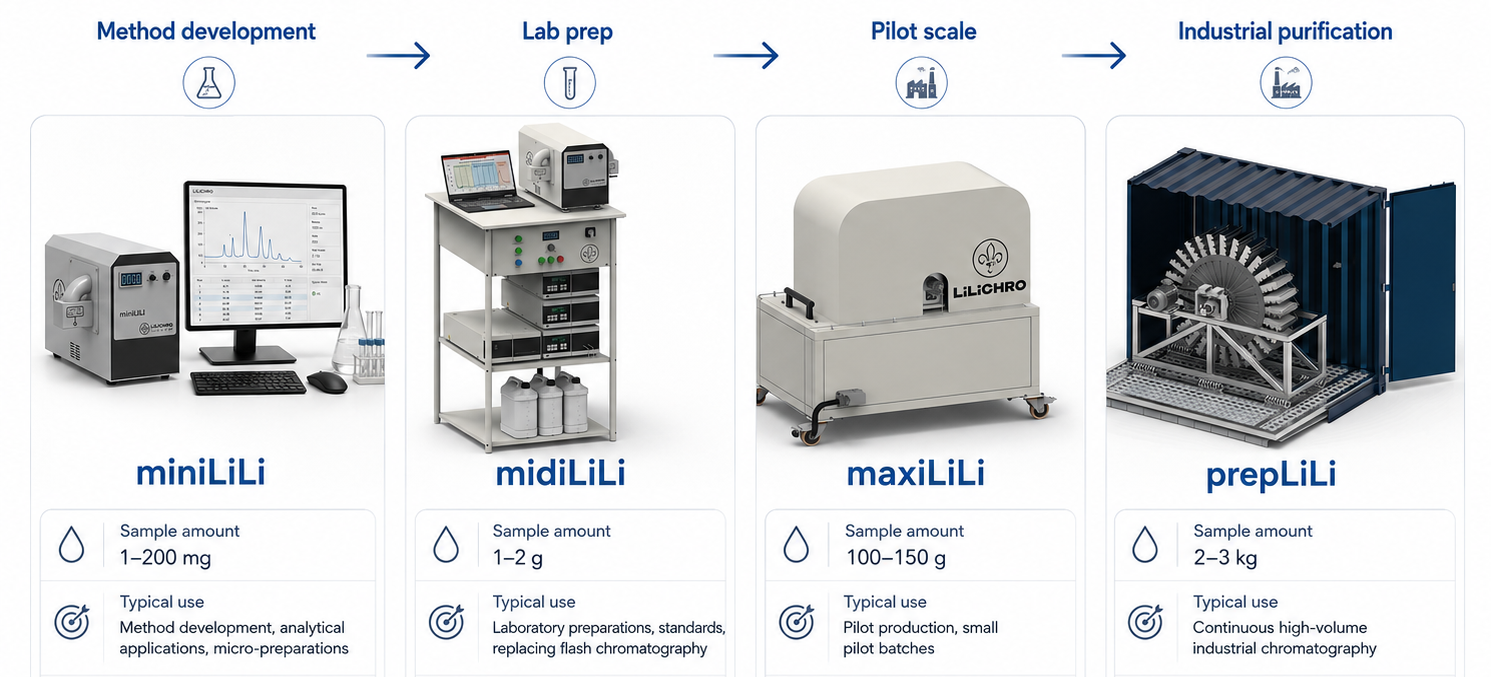
The Z-cell architecture delivers exceptional stationary phase retention across a wide range of operating conditions, enabling robust method transfer between scales. Each cell chamber operates as an independent equilibrium stage, and the total number of theoretical plates in the system scales proportionally with rotor volume. When transitioning from a miniLiLi system with 25 mL capacity to a maxiLiLi system with multiple liters, the chromatographer simply maintains the same flow rate-to-volume ratio, injection volume-to-rotor capacity ratio, and phase system composition. The separation mechanism remains identical—only the absolute quantities change.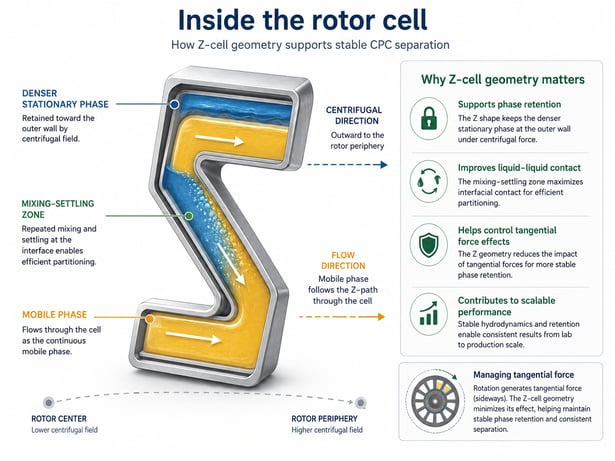
Modern helix cell designs represent an evolution of rotor geometry optimized for specific applications requiring enhanced stationary phase retention or improved resolution. Helix cells employ spiral-shaped channels that create more complex flow patterns and extended residence times, effectively increasing the number of partition events per unit volume. For separation scientists working with challenging purifications—where target compounds exhibit similar partition coefficients or where crude extract complexity demands maximum resolving power—helix cell configurations provide additional selectivity without sacrificing the fundamental scalability advantage inherent to liquid-liquid chromatography systems.
Traditional preparative chromatography approaches encounter well-documented obstacles during scale-up that stem directly from their reliance on solid stationary phases. As column diameter increases, maintaining uniform packing density becomes progressively more difficult. Variations in particle distribution create preferential flow channels—regions where mobile phase velocity exceeds the average, reducing effective contact time with stationary phase and degrading separation efficiency. This phenomenon, known as wall effects and radial dispersion, becomes more pronounced at production scale, leading to band broadening and diminished resolution that cannot be predicted from small-scale experiments.
Column fouling presents another scale-dependent challenge when processing crude pharmaceutical extracts or botanical preparations containing complex matrices. Waxes, lipids, proteins, and other high-molecular-weight contaminants accumulate irreversibly on solid stationary phase surfaces, progressively blocking active sites and restricting flow paths. While a laboratory-scale column might process dozens of injections before performance degrades noticeably, a production-scale column processing proportionally larger crude sample volumes can experience fouling after only a few cycles—necessitating frequent and costly column replacement or regeneration procedures that disrupt manufacturing schedules.
Irreversible adsorption constitutes a particularly insidious problem for pharmaceutical purification, where maximizing recovery of valuable active pharmaceutical ingredients directly impacts process economics. Strong hydrophobic interactions or ionic binding between target compounds and solid stationary phase surfaces result in permanent compound loss that worsens unpredictably with increasing sample load. A method delivering 92% recovery at analytical scale may yield only 75% recovery at production scale as adsorption sites become saturated and secondary interactions come into play—losses that prove difficult to anticipate during method development and impossible to recover once they occur.
Liquid-liquid chromatography eliminates these scale-up pitfalls by operating without any solid stationary phase. The absence of packing material means no wall effects, no fouling, no irreversible adsorption sites, and no scale-dependent flow distribution problems. The liquid stationary phase maintains constant composition and remains fully accessible throughout the separation regardless of rotor size. Crude extracts containing particulates or high-viscosity components that would rapidly destroy a packed column can be processed repeatedly in a two-liquid-phase system with no performance degradation. For chromatographers and separation managers tasked with scaling pharmaceutical purifications from feasibility studies through pilot programs to full industrial implementation, this elimination of scale-dependent variables transforms an uncertain, iterative process into a predictable engineering calculation.
Method development for liquid-liquid chromatography begins with solvent system selection—identifying a biphasic mixture that provides appropriate partition coefficients for the target compound and key impurities. Published biphasic solvent systems exist for more than 500 molecule types, providing validated starting points for most pharmaceutical applications including alkaloids, terpenoids, polyphenols, peptides, and small molecule APIs. A screening study evaluates crude material behavior in candidate solvent systems, measuring partition coefficients and establishing feasibility before committing to full method development. This initial investment in solvent system optimization pays dividends throughout the entire scale-up process.
Once an effective biphasic system is identified at laboratory scale using a miniLiLi or midiLiLi system, the transition to pilot scale requires only straightforward calculations. The critical parameters governing separation performance—partition coefficient, phase ratio, flow rate relative to rotor volume, and sample load relative to rotor capacity—remain constant across all scales. If a compound with partition coefficient K=2.5 separates successfully from an impurity with K=1.8 in a 250 mL rotor at 10 mL/min flow rate with 25 mL injection volume, the identical separation will occur in a 2.5 L rotor at 100 mL/min with 250 mL injection—a simple tenfold multiplication of all volumetric parameters.
This mathematical predictability eliminates the iterative reoptimization cycles that consume time and resources in traditional chromatography scale-up. There is no need to repack columns with different geometries, no adjustment of gradient profiles to compensate for extracolumn volume changes, no extensive revalidation to confirm that resolution and recovery remain acceptable. The separation scientist establishes optimal conditions once during initial method development, then applies straightforward volumetric scaling factors when moving to larger equipment. For pharmaceutical laboratories operating under strict quality management systems, this reproducibility translates directly to reduced validation burden and faster regulatory approval.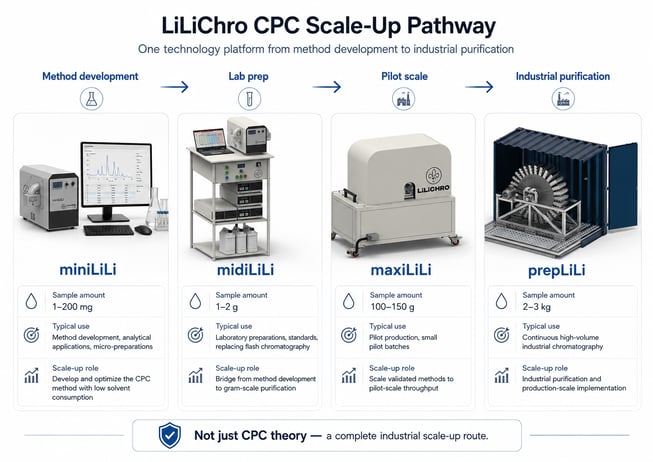
Integration with existing preparative HPLC workflows provides additional operational flexibility. Liquid-liquid chromatography excels as a complementary purification step, handling the initial bulk separation of crude extracts to remove major impurities while recovering target compounds at high yield. The enriched fractions can then undergo final polishing via preparative HPLC, which excels at high-resolution separations of relatively clean mixtures. This two-stage approach leverages the strengths of each technology—using support-free liquid-liquid separation to maximize recovery and minimize consumable costs for the high-volume, high-load initial separation, then applying solid-phase chromatography only for the lower-volume, lower-load final purification where its high resolution provides maximum value.
Industrial-scale liquid-liquid chromatography implementation requires attention to practical operational parameters beyond fundamental separation science. Solvent consumption and recovery economics become increasingly critical as purification volumes increase. While two-liquid-phase purification inherently uses less solvent than comparable solid-phase methods—because the liquid stationary phase is retained and recycled rather than discarded with each elution—production-scale operations benefit substantially from implementing solvent recycling systems. Modern distillation and phase separation equipment enables recovery and reuse of 85-95% of the biphasic solvent system, dramatically reducing both raw material costs and environmental impact.
Sample preparation and injection volume optimization directly impact production throughput. Liquid-liquid chromatography tolerates much higher sample concentrations than solid-phase methods because there are no stationary phase capacity limits or loading-dependent band broadening effects. Systems configured for industrial use can accept injection volumes representing 10-30% of rotor capacity, enabling processing of substantial crude extract quantities per cycle. For pharmaceutical manufacturers purifying botanical extracts, peptides, or synthetic intermediates, this high loading capacity translates to fewer cycles, faster batch completion, and improved facility utilization compared to preparative HPLC approaches limited to much lower loading factors.
Long-term operational considerations include maintenance requirements, consumable costs, and technology life cycle. The absence of columns, packing material, and solid stationary phases eliminates the recurring replacement costs that dominate solid-phase chromatography operating expenses. Routine maintenance involves only standard pump and valve service comparable to any liquid handling system. Rotors fabricated from chemically resistant materials withstand years of continuous operation without performance degradation. For heads of purification evaluating total cost of ownership across a five-to-ten-year equipment lifespan, the combination of lower consumable costs, reduced solvent consumption, higher compound recovery, and elimination of scale-up uncertainty positions liquid-liquid chromatography as a compelling alternative to conventional approaches for pharmaceutical active ingredient purification from laboratory through industrial production scales.
.png?width=1200&height=1200&name=LinkedIn%20posts%20(1).png)