

Natural extract purification is rarely a clean chromatographic exercise.
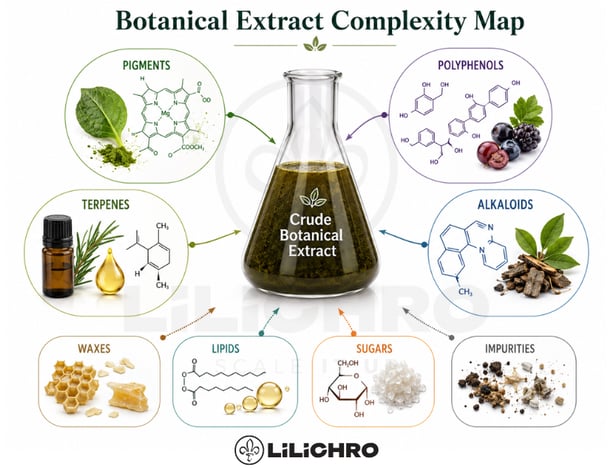
A botanical extract may contain the target compound, structurally similar analogues, pigments, waxes, tannins, sugars, lipids, terpenes, alkaloids, degradation products, and unknown matrix components in the same sample. For a purification expert used to HPLC or flash chromatography, the problem is familiar. The analytical method may look promising, but the preparative workflow becomes less forgiving.
The sample overloads the column. A valuable fraction adsorbs too strongly. The method works at small scale, but scale-up changes the economics. Or the crude extract simply behaves like a crude extract: messy, variable, and not very interested in respecting the clean logic of a packed column.
Liquid-liquid chromatography, including centrifugal partition chromatography (CPC), separates compounds between two immiscible liquid phases. Instead of using a solid stationary phase such as silica or bonded media, one liquid phase is retained in the instrument while the other moves through it. The separation depends on how each compound partitions between the two phases.
For botanical purification, that difference matters.
Why Botanical Extracts Challenge HPLC and Flash Workflows
HPLC and flash chromatography are essential tools in natural product purification. They are well understood, widely available, and often excellent for analytical confirmation, polishing, and targeted isolation.
But crude natural extracts create specific problems.
The first is complexity. Plant extracts rarely contain one clean impurity next to one clean target. They often contain families of related compounds. Polyphenols, flavonoids, alkaloids, terpenes, cannabinoids, pigments, and lipids may overlap in polarity and retention behavior.
The second is loading. A flash or preparative HPLC column has a practical sample limit. Once the crude extract overloads the stationary phase, resolution may fall quickly. This is especially frustrating when the target is present in a low or moderate concentration and the team needs preparative amounts.
The third is scale-up. A method that works on an analytical HPLC column does not always translate smoothly into preparative chromatography. Column dimensions, stationary phase cost, pressure limits, solvent consumption, gradient behavior, and fraction handling all become part of the problem.
The fourth is irreversible or inconvenient interaction with the solid phase. Some matrix components bind strongly, contaminate the column, or reduce column lifetime. For botanical purification teams, chlorophyll, waxes, and sticky nonpolar components can become practical headaches.
Liquid-liquid chromatography does not remove every one of these challenges. But it approaches them from a different direction.
What Changes with Liquid-Liquid Chromatography
In liquid-liquid chromatography, the main development variable is not which solid stationary phase to choose. It is which biphasic solvent system creates useful partitioning.
This changes the method development mindset.
Instead of asking, “Which column chemistry gives me the best retention?” the purification scientist asks, “Which two-phase solvent system distributes the target and impurities differently enough to separate them?”
That is a more extraction-like way of thinking, but it is still chromatography. The compounds move through a repeated partitioning process, and separation develops through many contact steps between the mobile and stationary liquid phases.
For botanical extracts, this can be useful because many natural compounds already behave differently between liquid phases. A flavonoid glycoside, a terpene, a chlorophyll fraction, and a lipophilic impurity may not need a solid surface to show different separation behavior. They may simply need the right two-liquid environment.
Flexibility Is the Main Advantage
The strongest argument for liquid-liquid chromatography in natural extract purification is flexibility.
With a CPC method, selectivity can be adjusted through solvent-system composition. Depending on the extract and compound class, the method developer can tune polarity, pH, ionic strength, solvent ratios, and phase behavior. This gives the team a broad experimental space before moving to preparative work.
That flexibility is especially relevant for:
- Polyphenols and antioxidant compounds
- Flavonoids and glycosides
- Alkaloids and nitrogen-containing plant compounds
- Terpenes and aroma compounds
- Cannabinoids and related botanical fractions
- Chlorophyll and pigment remediation
- Food-grade and nutraceutical extracts
- Cosmetic and botanical active ingredients
This does not mean CPC is automatically better than HPLC or flash chromatography. It means CPC can be worth testing when the bottleneck is not analytical detection, but preparative separation from a complex natural matrix.
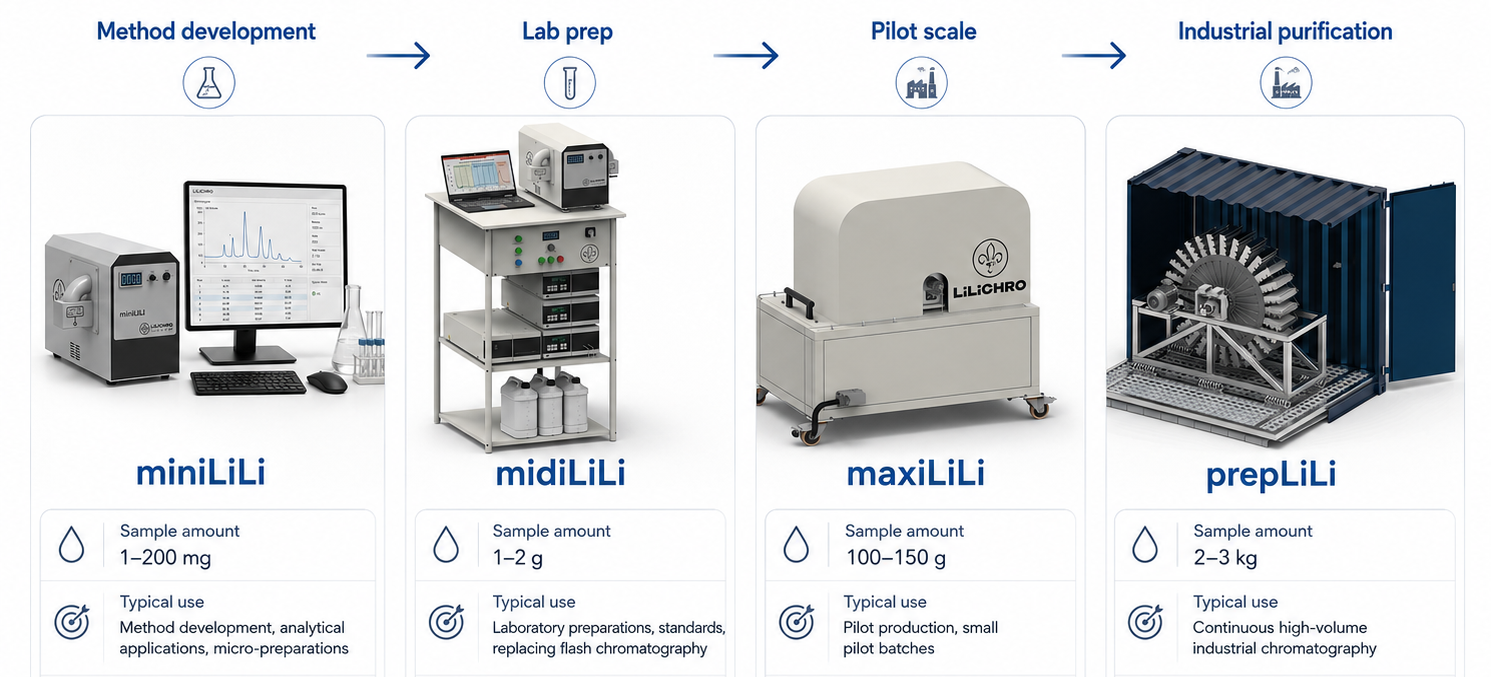
Lab-to-Preparative Scaling
One reason liquid-liquid chromatography is interesting for botanical purification is its scale-up logic.
In many workflows, development begins with small solvent-system tests. The goal is to find a biphasic system where the target compound has a useful partition coefficient and the main impurities distribute differently. Once that behavior is understood, the same separation principle can guide larger-scale CPC work.
For a team used to HPLC, this is an important difference. In solid-phase chromatography, scale-up often means changing column geometry, particle size, loading strategy, pressure conditions, and sometimes even the economics of the method. In liquid-liquid chromatography, the two-phase system remains central. If the partitioning is technically useful, the scale-up discussion can focus more directly on loading, flow, rotor volume, phase retention, solvent handling, and fraction strategy.

Practical Botanical Use Cases
Liquid-liquid chromatography is not only for final isolation. In botanical purification, it can support several practical goals.
Target compound isolation
A team may need to isolate a bioactive compound from a crude or semi-refined extract. Examples include EGCG from green tea extract, flavonoids from plant materials, or alkaloids from botanical fractions.
Pigment and matrix removal
Sometimes the goal is not to collect the most valuable molecule immediately. It is to remove chlorophyll, lipophilic impurities, or other matrix components that make downstream purification difficult.
Fraction enrichment
CPC can help enrich a compound class before polishing by another technique. This can be useful when preparative HPLC is too expensive or overloaded at the crude-extract stage.
Food, nutraceutical, and cosmetic applications
Natural extract purification is highly relevant for food-grade ingredients, nutraceutical actives, botanical antioxidants, flavoring materials, pigments, and cosmetic plant-derived compounds.
Side-stream evaluation
Botanical processing often creates waste or side fractions. A liquid-liquid chromatography screening study can help determine whether those fractions contain recoverable value.
Where LiLiChro Fits
LiLiChro’s technology fits this category because its equipment is built around liquid-liquid chromatography and CPC. The important point is not only that the systems are CPC instruments. The important point is that the separation happens between two liquid phases.
That makes LiLiChro relevant for botanical purification teams that want to test whether a natural extract can be separated through partition behavior rather than solid-phase retention.
LiLiChro’s application notes show this direction clearly. The examples include EGCG purification from green tea polyphenol extract, chlorophyll removal from vegetable extracts, flavoring material purification from biological samples, and miniLiLi method development work with loading tests. These are useful examples because they connect the technology to real natural matrices rather than only ideal model mixtures.
For teams working with HPLC or flash chromatography, the most practical first step is not to replace an existing workflow blindly. It is to test whether liquid-liquid chromatography solves the bottleneck that solid-phase chromatography is struggling with.
Conclusion
Natural extract purification is difficult because botanical samples are chemically rich, variable, and often unforgiving at preparative scale. HPLC and flash chromatography remain valuable tools, but they are not the only way to think about purification.
Liquid-liquid chromatography gives purification teams a different route. By focusing on partitioning between two liquid phases, CPC can help with flexible method development, complex matrix handling, pigment or impurity removal, fraction enrichment, and lab-to-preparative scaling.
For botanical purification experts, the key question is not whether CPC is universally better. It is whether the extract contains compounds that partition in a useful way.
Next Step
If you are working with a botanical extract, natural product fraction, pigment-rich sample, or difficult plant matrix, request a LiLiChro screening study. It is the most practical way to test whether liquid-liquid chromatography is technically relevant before committing to a full preparative workflow.
.png?width=1200&height=1200&name=LinkedIn%20posts%20(1).png)