CPC
LLIBS

Two enantiomers have the same molecular formula and nearly identical physical properties, yet may behave differently in a biological system. One may deliver the intended effect while the other is less active, inactive or produces a different response. This makes enantiomeric purity important in pharmaceuticals, fine chemicals, flavors, fragrances and natural products.
Chirality cannot usually be resolved by an ordinary separation based only on polarity, boiling point or molecular size. The process needs a chiral interaction or a reaction that converts the enantiomers into species that no longer behave identically.
Enantiomers have identical physical properties in an achiral environment, including solubility, melting point and boiling point. The main exception is optical activity: they rotate plane-polarized light by equal amounts in opposite directions.
Because conventional separation methods rely on differences in physical or chemical properties, they cannot distinguish between enantiomers under achiral conditions. Separation requires a chiral environment created by a chiral selector, enzyme or derivatizing reagent.
The resulting selectivity may depend on small differences in hydrogen bonding, steric fit, ionic interactions and solvation. A selector that works for one compound may fail for a structurally similar molecule. Molecular structure can guide method selection, but experimental screening is still required to determine whether useful separation can be achieved.
Natural biosynthesis is often stereoselective because enzymes are chiral. An extract may contain one dominant enantiomer, but also related stereoisomers, degradation products and a complex matrix. Conventional synthesis may instead produce a racemate unless it uses a stereoselective catalyst, chiral starting material or another asymmetric strategy. The process developer must then prevent racemate formation or resolve the mixture afterward.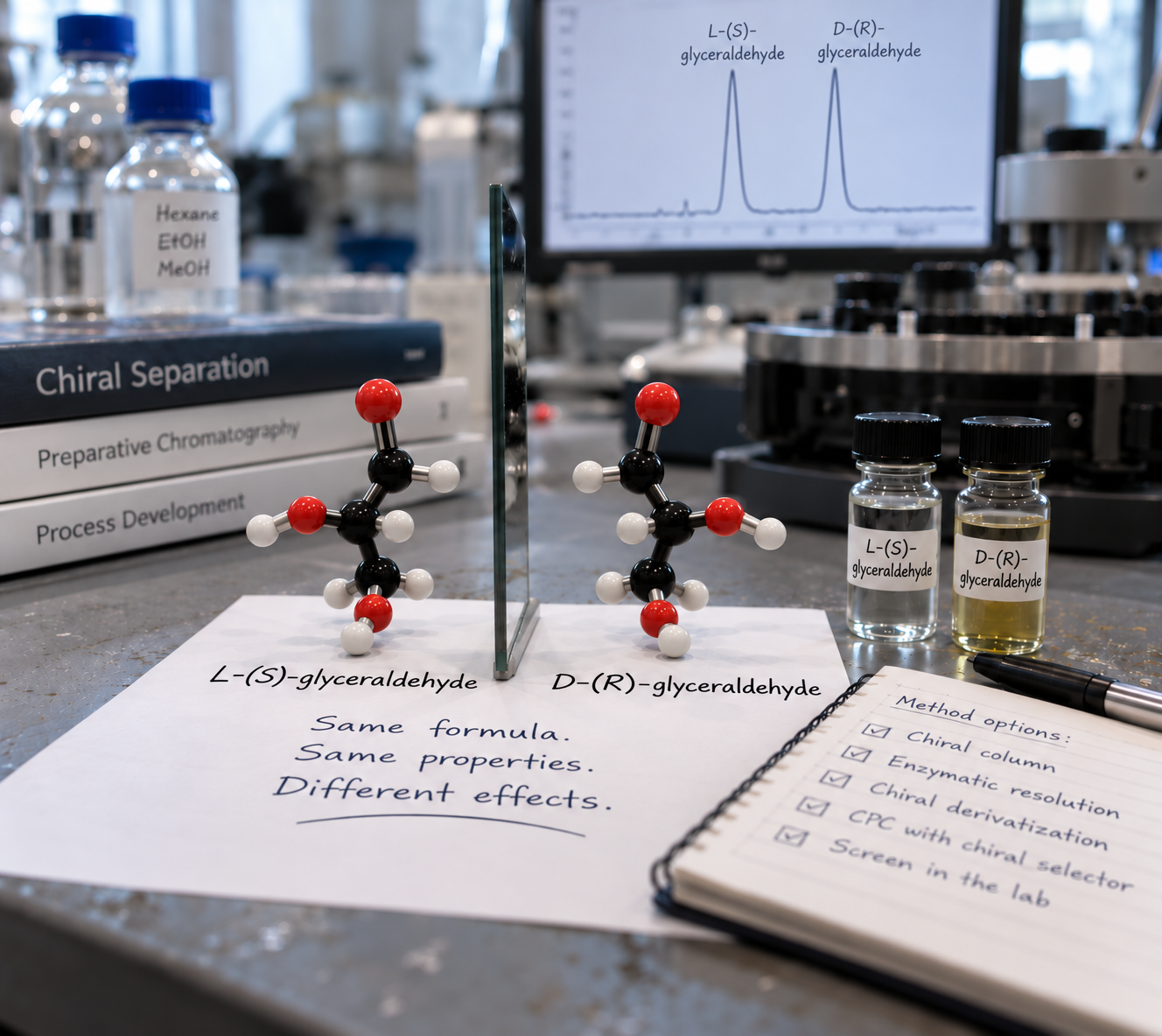
Direct chiral chromatography separates enantiomers through reversible interactions with a chiral selector, without chemically modifying the target compound. The selector forms transient complexes of different stability with the two enantiomers, causing them to move through the chromatographic system at different rates.
This principle can be implemented in several ways:
Both technologies require experimental screening because chiral recognition is highly compound-specific. Selector chemistry, solvent composition, additives, pH, temperature and sample loading can all influence selectivity.
These approaches are well established analytically but can become expensive at preparative scale. Chiral HPLC may require costly dedicated columns and repeated chromatographic cycles, while chiral CPC requires a suitable selector and biphasic solvent system. CPC avoids the cost and loading limitations associated with a packed chiral column, but selector cost, recovery and stationary-phase retention must still be considered.
Enzymes are themselves chiral macromolecules. Their three-dimensional active sites can therefore recognize the two enantiomers of a substrate differently. One enantiomer may fit the active site more effectively and react faster than the other.
Lipases, for example, can catalyze enantioselective hydrolysis, esterification or transesterification. The resulting product and the unreacted enantiomer have different chemical properties and can subsequently be separated by conventional chromatography, CPC, crystallization or extraction.
Enzymatic kinetic resolution can provide high selectivity under mild conditions, but its applicability depends strongly on the substrate and the availability of a suitable enzyme. Classical kinetic resolution also has an inherent yield limitation: without simultaneous racemization, a maximum of 50% of the starting racemate can theoretically be recovered as the selected enantiomer in a single ideal resolution.
In the indirect approach, the racemate is reacted with an enantiopure chiral reagent. This converts the two enantiomers into diastereomers.
Unlike enantiomers, diastereomers have different physical and chemical properties. They can therefore be separated using conventional achiral HPLC, CPC, crystallization or another standard purification method. After separation, the introduced chiral group is removed to recover the desired enantiomer.
When a suitable derivatization reaction is available, this is often the least expensive practical approach because it avoids the need for a dedicated chiral stationary phase. It is also frequently used in analytical workflows.
For preparative applications, however, the complete process must be considered. Derivatization introduces an additional reaction step followed by separation and removal of the chiral group. Reagent cost, conversion, recovery, deprotection yield, waste generation and the possibility of racemization can all affect the final economics.
Chiral recognition depends on three-dimensional fit, solvent effects and association equilibria. Real samples add solubility, concentration, impurities and matrix effects. These variables cannot yet be predicted reliably from a two-dimensional structure alone.
A practical assessment should therefore answer three questions experimentally:
The strongest business case is usually found in high-value compounds, products with strict stereochemical requirements, or processes where the undesired enantiomer creates a safety, efficacy or quality risk. The decision should compare product value with development time, consumables, selector or enzyme cost, solvent handling, yield, cycle time and possible recycling of the unwanted enantiomer.
There is no universally best chiral separation method. Chiral HPLC, enzyme-based resolution, chiral derivatization and chiral CPC solve different versions of the same problem. The right starting point comes from the molecule; the final answer comes from experimental data. From a manufacturing-cost perspective, enzyme-based kinetic resolution or derivatization with a chiral reagent may provide the most economical route to enantiomeric purity.
Next step: If a chiral purification is limiting your process, LiLiChro can review the compound, current method and required scale to determine whether chiral-selector-based CPC is realistically worth screening.