CPC
HPLC
chromatography

Selecting a biphasic solvent system is one of the most important—and often most time-consuming—steps in developing a liquid–liquid chromatographic separation. Established solvent families such as Arizona and HEMWat provide useful polarity ranges for initial screening. However, a system that works during small-scale partitioning experiments is not necessarily practical at preparative scale.
LLIBS—the Liquid–Liquid Isolation Biphasic System by LiLiChro—was developed to provide a more practical starting framework for preparative liquid–liquid separation.
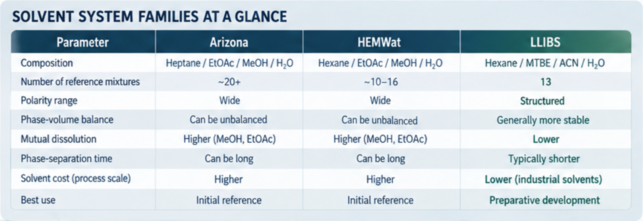
The Arizona and HEMWat families are widely used because their composition can be adjusted across a broad polarity range. Both are four-component systems:
This flexibility is useful in method development, but it can introduce practical disadvantages as the required solvent volume increases.
Some Arizona and HEMWat compositions produce highly unequal upper- and lower-phase volumes. At analytical scale, this may be manageable. However, at preparative scale, a strongly unbalanced phase ratio can require the preparation of a large total solvent volume to obtain enough of the required mobile or stationary phase.
The unused excess phase increases solvent consumption, preparation time, storage requirements and waste generation.
Methanol and ethyl acetate act as polarity modifiers but also increase interaction between the nominally aqueous and organic phases. Their distribution between the two phases can influence phase composition, phase volume and settling behaviour.
At larger scale, greater mutual dissolution can make solvent preparation and phase recovery less predictable. Changes in temperature, composition or solvent purity may also alter phase behaviour. These effects matter when tens or hundreds of litres must be prepared reproducibly.
A solvent mixture must form two clearly separated phases before it can be used reliably in preparative liquid–liquid chromatography. Slow settling delays solvent preparation and can indicate a system that is more sensitive to mixing intensity, sample composition or temperature.
Crude feeds may further complicate phase separation by introducing emulsifying compounds, lipids, salts or fine suspended material. A solvent system that separates adequately in a clean test tube may therefore become less convenient under real preparative conditions.
The cost of a biphasic system is not determined only by the price per litre. It also depends on:
Arizona and HEMWat remain valuable reference families, but their solvent composition and phase behaviour can make them unnecessarily expensive or operationally inconvenient for some preparative processes.
LLIBS consists of 13 reference mixtures based on hexane, MTBE, acetonitrile and water. The series covers a structured polarity range while focusing on properties that become especially relevant during scale-up.
Its practical characteristics include:
These characteristics do not guarantee that an LLIBS composition will provide the required selectivity for every compound. Partition coefficients and selectivity remain compound-specific. The value of LLIBS is that it provides preparatively practical starting compositions before detailed optimisation begins.
A small difference in solvent cost may be insignificant during vial-scale screening. The same difference becomes important when a process consumes hundreds or thousands of litres.
LLIBS uses solvents that are widely available in industrial grades and can provide a lower-cost alternative to conventional reference systems. Its reduced mutual phase dissolution and more favourable phase formation can also decrease the total solvent volume required to generate a usable quantity of each phase.
The economic advantage therefore comes from more than replacing one solvent with another. It can include:
The actual saving must still be calculated using the selected composition, required phase volumes, local solvent prices and the intended recovery strategy.
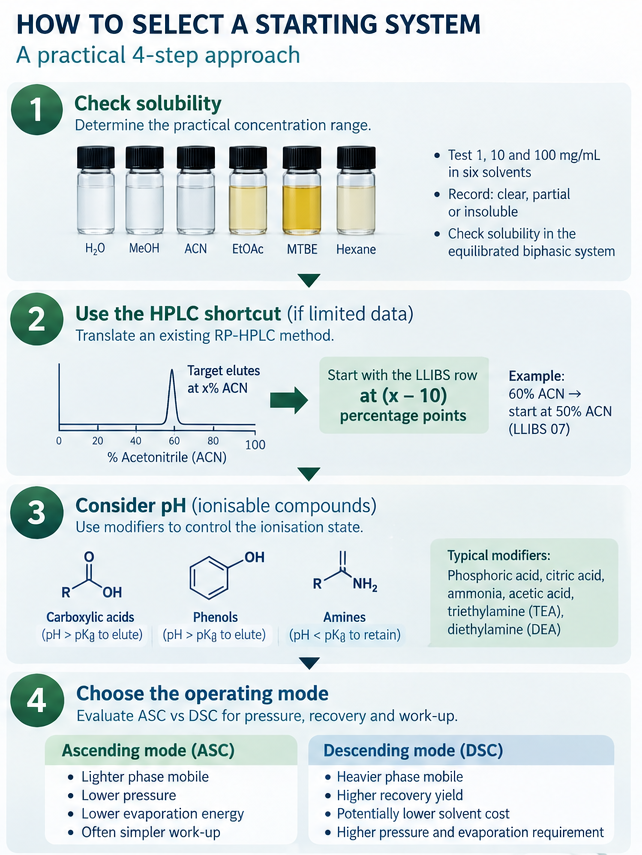
The target compound and sample matrix must remain sufficiently soluble in the biphasic mixture. A theoretically suitable polarity is irrelevant if the sample precipitates during injection or phase equilibration.
Solubility should therefore be checked in the complete equilibrated system, not only in one pure solvent. Both phases should also be inspected after equilibration because precipitation may occur when the sample encounters the second phase.
An existing reversed-phase HPLC method can provide a practical polarity reference.
If the target compound elutes appropriately at a mobile-phase composition containing x% acetonitrile, the first LLIBS starting point should be the row corresponding to (x − 10) percentage points.
For example:
60% acetonitrile in the HPLC method → begin screening around the LLIBS 50 composition.
This is an empirical selection rule for identifying a reasonable starting system. It does not mean that reversed-phase retention and liquid–liquid partitioning are mechanistically identical. The proposed composition must still be tested experimentally.
For ionisable compounds—including amines, carboxylic acids and phenols—partition behaviour may change substantially with pH.
The neutral and ionised forms of a compound can have very different affinities for the two phases. Adjusting pH can therefore improve solubility, change the partition coefficient or create useful selectivity between structurally related compounds.
However, pH modification must be evaluated together with:
When solubility, HPLC data or pH behaviour does not identify a clear starting point, the most reliable route is systematic experimentation.
The objective is not to test every possible solvent composition. It is to establish the required direction of change:
A promising solvent system should provide suitable partitioning and selectivity while also meeting preparative requirements for solubility, phase stability, settling time, stationary-phase retention and solvent cost.
If the direction is unclear, request technical advice before expanding the screening range. A short review of the target compound, sample matrix, existing chromatographic data and required scale can prevent a large amount of unnecessary experimentation.
Arizona, HEMWat and LLIBS are starting references, not universal methods. Final system selection must be supported by experimental measurements of partition coefficient, selectivity, solubility, phase ratio and phase-separation behaviour.
The difference is that LLIBS was structured around the practical requirements of preparative liquid–liquid separation. Its value becomes most visible when solvent consumption, phase preparation, settling time and repeated operation matter as much as chromatographic selectivity.
For laboratories moving from screening toward production, this can make solvent-system development faster, more economical and easier to scale. Contact us for the high-resolution reference guide poster.