
.png?width=1200&height=628&name=HubSpot%20Blog%20Post%20Header%20(5).png)
CPC
technical
-1.png?width=1200&height=628&name=HubSpot%20Blog%20Post%20Header%20(4)-1.png)

A C18 method may deliver excellent separation on an analytical HPLC—and still become impractical when production volume increases.
The difficulty is not simply that a preparative column is larger. The problem is transferring a method operating at 100–300 bar, or even higher in UHPLC, into equipment that must process substantially more material safely and economically.
Pressure drop across a packed C18 column is mainly influenced by:
Small particles provide high efficiency but create strong resistance to flow. This is acceptable analytically, where flow rates and column diameters are small. In preparative production, however, the required solvent flow, pump capacity and mechanical load increase substantially.
Industrial chromatography equipment can be designed for high pressure, but doing so makes pumps, seals, tubing, valves and columns more expensive. In many industrial process environments, even 50 bar is already considered significant. By comparison, many conventional process vessels operate at only a few bar.
The question therefore becomes: how can pressure be reduced?
The most direct approach is to replace the small analytical particles with larger preparative particles. Larger particles create less flow resistance and therefore reduce column entry pressure.
The trade-off is lower column efficiency. More importantly, changing particle size may also mean changing the silica material, surface characteristics or packing quality. Even when both materials are labelled C18, they may not provide identical selectivity.
The analytical separation therefore cannot simply be assumed to transfer. The preparative stationary phase must be tested again for resolution, loading capacity and recovery.
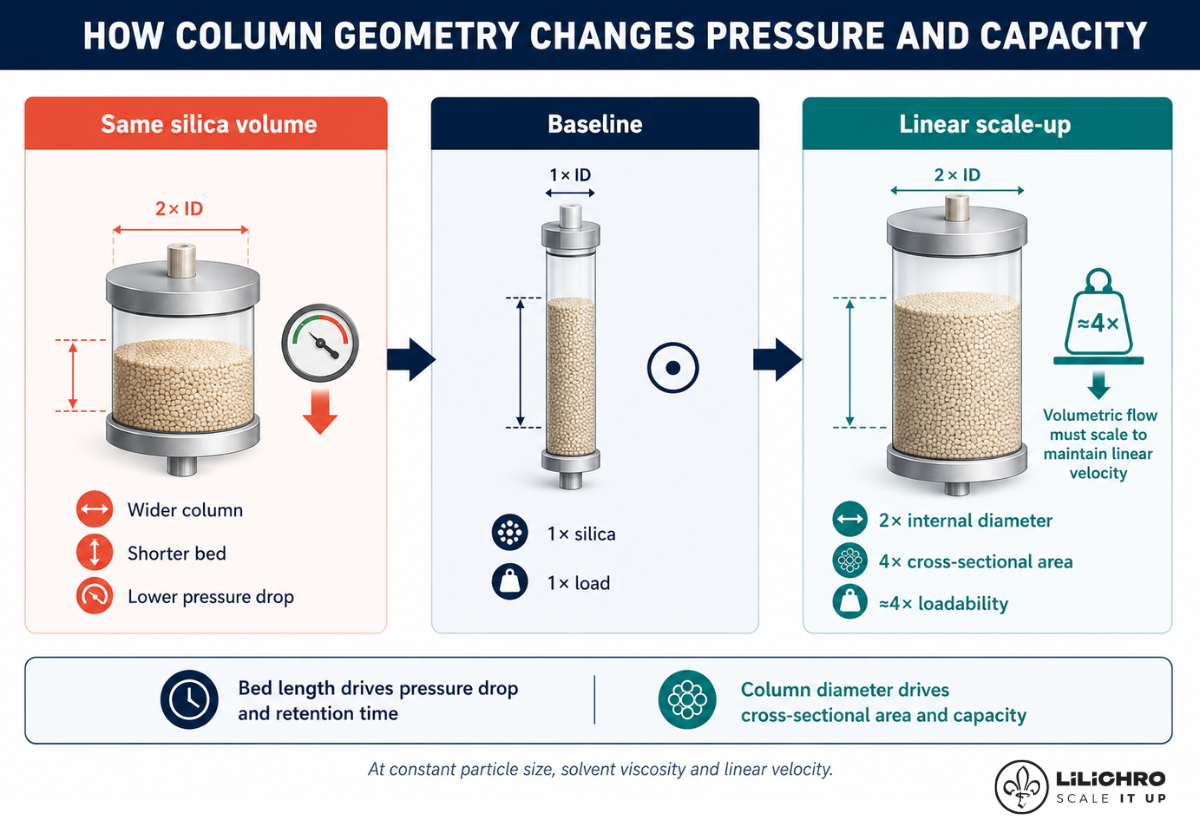
If the same amount of silica gel is used, increasing the column diameter reduces pressure because the resulting packed bed is shorter.
If the same amount of silica gel is used, increasing the column diameter reduces pressure because the resulting packed bed is shorter.
A common scale-up strategy is to maintain the bed length and particle size while increasing column diameter. Column length determines the separation path, while diameter increases cross-sectional area and therefore sample capacity.
This is the basis of the linear scale-up approach described by YMC. If the column diameter doubles, its cross-sectional area—and theoretically its loading capacity—increases approximately fourfold. Flow rate must increase by the same factor to maintain the original linear velocity.
Increasing diameter does not inherently increase pressure drop across the packed bed when column length, particle size, solvent viscosity and linear velocity remain unchanged. It does, however, create a serious engineering challenge.
Pressure acts across the column’s cross-sectional area. Doubling the diameter produces four times the end-plate area, so the column structure must withstand approximately four times the axial force at the same operating pressure. Wider columns also require more powerful pumps, higher volumetric flow and increasingly uniform flow distribution.
This introduces another scale-up risk: injection and distribution. A small analytical sample enters the column close to a single point. Across a wide preparative bed, the feed must be distributed uniformly. Uneven packing, wall effects or poor inlet distribution can distort the band and reduce the separation quality demonstrated on the analytical column.
The result is not merely a bigger version of the original system. It is a different piece of process equipment with new mechanical and chromatographic constraints.
If production volume makes high-pressure C18 impractical, two lower-pressure alternatives deserve consideration.
Normal phase typically uses low-viscosity, predominantly non-polar solvents. On the same packed bed, pressure can be substantially lower than with aqueous reversed-phase eluents—under suitable conditions, potentially by close to an order of magnitude.
However, this is not a direct transfer of the C18 method. It requires new method development based on different selectivity, adsorption behaviour and sample solubility. Pressure may also rise again when more viscous polar modifiers are introduced.
Liquid–liquid chromatography removes the packed solid bed entirely. In second-generation centrifugal partition chromatography systems, the liquid stationary phase is retained inside the rotor by centrifugal force.
Without densely packed silica particles, CPC can operate effectively at approximately 5–10 bar, depending on the instrument, solvent system and flow conditions. This changes the scale-up problem fundamentally: capacity is no longer tied to forcing mobile phase through a high-resistance packed bed.
LiLiChro’s Screening Study determines whether your separation has the liquid–liquid partition behaviour required to make that route worth developing.
.png?width=1200&height=628&name=lilichro%20blog%20cpc%20natural%20extract%20purification%20(1).png)