Pharma
R&D Director
Where Centrifugal Partition Chromatography (CPC) Fits in Modern Pharma R&D

LiliChro
Purification is often invisible in pharmaceutical R&D until it slows everything down.
An analytical method may work, but fail at preparative scale. A crude sample may overload the column. A valuable impurity, peptide, degradation product, or natural-product-derived compound may be lost during purification. The chromatogram can look acceptable while the recovery tells a different story.
HPLC remains essential in pharmaceutical analysis and purification. It is precise, familiar, and deeply embedded in regulated workflows. But not every purification challenge is best solved by pushing more material through a packed solid-phase column.
This is where centrifugal partition chromatography, or CPC chromatography, deserves attention. CPC is not a universal replacement for HPLC, flash chromatography, SFC, CCC, or other established methods. Its value is more specific: a support-free, liquid-liquid separation mechanism that can help when solid-phase workflows are limited by adsorption, fouling, low loading capacity, difficult scale-up, solvent burden, or poor recovery.
For a pharmaceutical R&D director, the real question is not: “Is CPC better than HPLC?”
It is: “Which purification problems are we forcing through solid-phase workflows because we have not evaluated a liquid-liquid alternative?”
The purification problem pharma R&D teams already know
Most pharma organizations already have strong chromatographic infrastructure. The issue is not a lack of chromatography. The issue is that many purification challenges sit awkwardly between familiar categories.
Analytical HPLC may show that separation is possible, but the method may not carry enough load. Preparative HPLC may deliver purity, but at the cost of long run times, expensive columns, intensive sample preparation, and significant solvent use. Flash chromatography may be fast, but not selective enough. SFC may be excellent for certain chiral or non-polar separations, but not suitable for every crude or highly complex matrix.
The result is a common R&D bottleneck: the team knows what it wants to isolate, but the available method is too slow, too wasteful, too fragile, too expensive, or too difficult to scale.
For an R&D director, this is not only a technical inconvenience. It is a decision risk. Poor purification slows biological testing, delays impurity characterization, consumes scarce material, and can push teams toward routes that look acceptable at small scale but become painful later.
The practical questions are broader than “Can we separate the peaks?”
Can we recover the compound? Can we load enough material? Can we avoid losing the target on the stationary phase? Can we repeat the method? Can the method scale beyond the first successful run? Can we reduce unnecessary sample preparation?
CPC becomes relevant because it addresses several of these questions through a fundamentally different separation mechanism.
What CPC is, in practical terms
Centrifugal partition chromatography is a form of liquid-liquid chromatography. Instead of using a solid stationary phase such as silica or resin, CPC uses two immiscible liquid phases. One liquid phase is retained inside a rotating rotor by centrifugal force. The other liquid phase is pumped through it as the mobile phase.
Compounds separate according to how they distribute between the two liquid phases. This distribution is described by the partition coefficient, often written as K. In practical terms, K tells you whether a compound prefers one phase, the other phase, or divides between both.
The “column” in CPC is not a packed bed. It is a series of cells or chambers inside a rotor. As the rotor spins, centrifugal force holds the stationary liquid phase in place while the mobile phase travels through the system. The repeated interaction between the two phases creates chromatographic separation.
A useful way to think about CPC is this:
CPC behaves like a highly controlled series of liquid-liquid extraction steps inside a chromatographic instrument.
That simple statement matters. Many pharmaceutical scientists already understand liquid-liquid extraction. CPC takes that partitioning logic and gives it chromatographic control, repeatability, fraction collection, and preparative usefulness.
Because there is no solid stationary phase, CPC changes the nature of the purification problem. There is no silica surface for compounds to irreversibly adsorb onto. There is no packed bed to compress. There are no traditional column frits waiting to become everyone’s least favorite troubleshooting topic.
That does not make CPC effortless. Solvent-system selection is central to success. The team must identify a biphasic solvent system where the target and impurities partition differently enough to separate. But once that system is found, CPC can offer a flexible and scalable alternative to solid-phase purification.
Why CPC matters for pharma R&D
It provides an orthogonal separation mechanism
Pharma R&D teams often talk about orthogonality in analytical methods, but it is just as important in preparative purification.
In HPLC, selectivity depends heavily on stationary-phase chemistry, mobile phase composition, gradient, pH, additives, temperature, and other parameters. This gives enormous power, but the method remains anchored to a solid surface.
CPC changes the basis of selectivity. The stationary phase is a liquid selected by the user. By changing the biphasic solvent system, the scientist changes the chemical environment of the separation.
This can be valuable when compounds behave poorly on solid phases or when closely related structures do not separate well by standard reversed-phase or normal-phase logic. Instead of asking how a molecule interacts with silica, C18, phenyl, ion-exchange, or another fixed chemistry, CPC asks how the molecule distributes between two liquid environments.
For pharma R&D, that gives the team another route when a separation is technically possible but practically frustrating.
It can reduce sample loss
In early R&D, losing material is not just inefficient. It can delay decisions.
A few milligrams of a rare impurity, unstable intermediate, or difficult natural-product-derived compound may represent days or weeks of upstream work. If that compound adsorbs irreversibly to a packed column, the chromatogram may not immediately explain the full loss. The team may see broad peaks, missing recovery, poor mass balance, or inconsistent yields.
Because CPC does not use a solid stationary phase, it can reduce one classic cause of unrecovered material: irreversible adsorption to the solid support. At the end of a CPC run, the liquid stationary phase can be displaced, which supports recovery and mass-balance assessment in suitable systems.
This is not a promise that every CPC method is automatically lossless. Compounds can still degrade, partition poorly, emulsify, precipitate, or behave unexpectedly. But CPC removes one major source of loss from the equation: the solid stationary phase itself.
It can handle difficult sample matrices
Many purification workflows become inefficient before chromatography even begins. The team may need to filter aggressively, remove particulates, reduce lipids, exchange solvents, or simplify the matrix enough to protect the column.
Sometimes this preparation is scientifically necessary. Sometimes it is mainly there because the column cannot tolerate the sample.
CPC can be more forgiving because the separation environment is liquid-liquid and the rotor chambers are not equivalent to a tightly packed bed. This can make CPC useful for crude samples or complex matrices that would quickly foul a traditional column.
For pharma R&D, this can be especially useful when the sample is not a clean synthetic intermediate, but a crude reaction mixture, fermentation-derived material, degradation mixture, natural product fraction, peptide mixture, or impurity-rich matrix.
Common pharma R&D use cases for CPC
CPC is often associated with natural products and botanicals, but its relevance is broader. In pharma R&D, it can be useful wherever liquid-liquid partitioning provides a practical separation route.
Impurity isolation is one of the most natural use cases. Teams often need enough impurity material for structure elucidation, reference standard preparation, stability studies, toxicology support, or process understanding. CPC can be considered when an impurity has useful partition behavior and recovery matters as much as resolution.
Natural-product-derived compounds are another strong fit. Extracts and fractions can contain closely related analogues, pigments, lipids, tannins, sugars, and other matrix components. CPC can act as an early or intermediate purification step because it can fractionate complex mixtures without relying on a solid support.
Peptides and sensitive molecules may also benefit in selected cases. These compounds can present challenges related to adsorption, degradation, aggregation, or poor recovery. CPC is worth evaluating when the molecule is compatible with a biphasic system and when a gentler support-free environment may help.
Crude reaction mixture cleanup is another practical area. CPC can sometimes act as a first-pass fractionation tool, reducing complexity before final polishing or analysis. The goal is not always final API-grade purity in one step. Sometimes the goal is to remove enough matrix, byproducts, or interfering material to make the rest of the workflow easier.
When CPC should enter the conversation
CPC should not be considered only after every other method has failed. By then, time has already been lost, material may have been consumed, and the team may be locked into assumptions that are hard to unwind.
A better approach is to include CPC in the evaluation when the purification problem shows warning signs.
|
Symptom in the current workflow |
Why CPC may be worth evaluating |
|
Poor mass balance after preparative HPLC |
CPC removes the solid stationary phase as one source of irreversible adsorption |
|
Crude matrix fouls packed columns |
Liquid-liquid separation may tolerate difficult feeds better |
|
Analytical HPLC works, but preparative loading is poor |
CPC may provide a higher-load fractionation route before polishing |
|
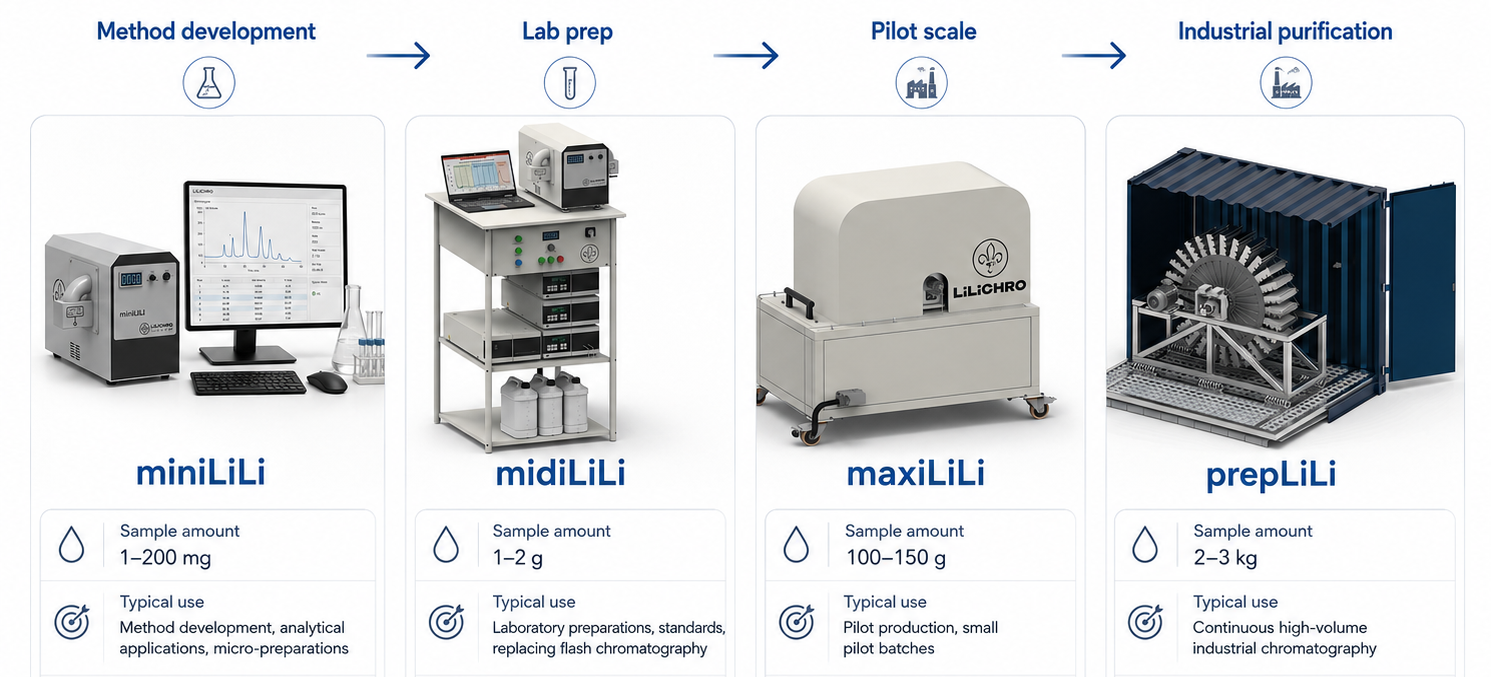
The team needs grams, not only analytical confirmation |
CPC can support scale-aware method development when the solvent system is suitable |
|
The compound class repeatedly behaves poorly on silica or bonded phases |
CPC provides an orthogonal partition-based mechanism |
|
Solvent and consumable burden are becoming significant |
CPC may reduce dependence on disposable solid stationary phases |
The key is not to use CPC because it is novel. Novelty is not a method-development strategy. The reason to use CPC is that the purification problem has symptoms that match the strengths of liquid-liquid chromatography.
Where CPC is not the right first choice
A credible discussion of CPC has to include its limitations.
CPC is not the right answer for every purification problem. If an existing HPLC method is fast, reproducible, economical, and easily scaled to the required amount of material, there may be no reason to change. If the target requires extremely high final polishing and the current packed-bed method performs well, HPLC may remain the best final step.
CPC also depends on solvent-system development. If a suitable biphasic solvent system cannot be identified, the method will not work. If the compound is unstable in the solvent systems that provide useful partitioning, CPC may not be appropriate. If the mixture forms persistent emulsions or the phases do not settle cleanly, method development becomes more difficult.
Teams also need the right expertise. CPC is not difficult because the concept is impossible. It is difficult when teams try to treat it like HPLC with a different instrument. Successful CPC work requires comfort with partition coefficients, phase ratios, solvent-system screening, phase retention, elution mode, and fraction recovery.
A poorly designed CPC screen can make a good technology look unsuitable. A well-designed screen can quickly show whether liquid-liquid chromatography deserves a place in the workflow.
Conclusion
Centrifugal partition chromatography has a specific and valuable place in modern pharma R&D.
It does not make HPLC obsolete. It does not remove the need for careful method development. It does not solve every purification problem. But it does offer a different way to think about preparative separation.
For R&D directors, that difference matters. CPC gives teams a support-free, liquid-liquid chromatography option when the current workflow is limited by adsorption, fouling, poor recovery, low loading, solvent burden, or uncertain scale-up. It can serve as an orthogonal method, a pre-fractionation step, an impurity isolation tool, or a scale-aware purification route.
The strongest case for CPC is not based on novelty. It is based on fit.
In mature R&D organizations, better purification does not come from loyalty to one platform. It comes from knowing when the molecule is telling you to change the separation mechanism.
Read our application notes to see how liquid-liquid chromatography can support difficult purification challenges in pharma R&D.